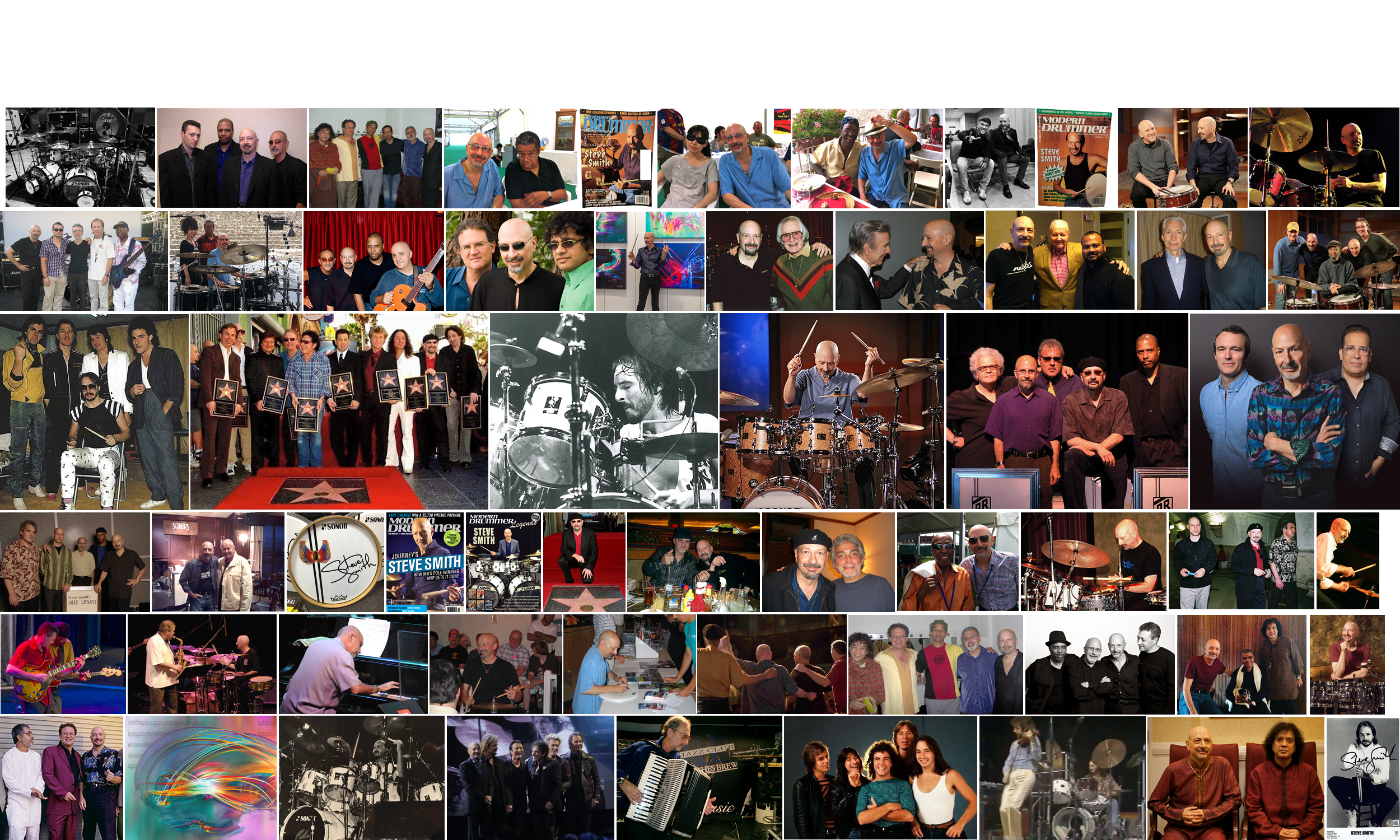
About Steve Smith

Click here to open the
Steve Smith Discography
Biography of Steve Smith
Steve Smith is one of the most influential and versatile drummers of the modern era. His musical voice, while distinctly contemporary, embodies the rich history and evolution of American music, drawing from jazz, rock, fusion, rhythm and blues, and world music traditions. Over a career spanning five decades, Smith has earned international recognition as a bandleader, recording artist, sideman, educator, and innovator, inspiring generations of musicians across multiple genres.
Smith is active as the leader of Steve Smith and Vital Information, one of the longest-running and most respected groups in contemporary jazz. He has also performed and recorded with a remarkable range of artists, including Journey, Steps Ahead, Jean-Luc Ponty, Mike Stern, Hiromi, Zakir Hussain's Masters of Percussion, Ahmad Jamal, Randy Brecker, Michael Brecker, Benny Golson, Buddy DeFranco, Dave Liebman, Bill Evans, and many others.
Born and raised in the Boston area, Smith began playing drums at age nine in 1963. He studied at Berklee College of Music from 1972 to 1976, where his principal teachers included legendary instructors Alan Dawson and Gary Chaffee. Shortly after leaving Berklee, Smith launched a professional career that would bridge the worlds of jazz and popular music at the highest levels.
As the drummer for Journey, Smith helped shape the sound of one of rock's most successful and enduring bands, appearing on many of the group's most celebrated recordings and performances. His work with Journey contributed to recordings that have sold well over 100 million copies worldwide. In recognition of Journey's cultural impact and enduring legacy, Smith was inducted into the Rock and Roll Hall of Fame as a member of the band in 2017.
Beyond his achievements in rock, Smith has been a major force in contemporary jazz and fusion. His work with pioneering groups such as Steps Ahead, Vital Information, and numerous all-star collaborations helped define the evolution of modern jazz fusion from the 1980s onward. As both a performer and recording artist, he has consistently combined technical mastery, musical sophistication, and deep respect for jazz tradition with a forward-looking creative vision.
A unique aspect of Smith's career has been his long-standing engagement with the rhythmic traditions of India. Through decades of collaboration with tabla maestro Zakir Hussain and other master musicians from India, Smith has studied and incorporated concepts from Carnatic and Hindustani music into his own artistic language. He has developed a deep understanding of konnakol—the South Indian art of vocalizing rhythm—and has become one of the foremost Western drumset artists to successfully integrate Indian rhythmic concepts into contemporary jazz and improvised music. These cross-cultural explorations have significantly expanded the vocabulary of modern drumset performance and rhythmic education.
As an educator, Smith has had an extraordinary impact on drummers worldwide. Through countless clinics, masterclasses, festivals, drum camps, university residencies, instructional books, videos, and online educational programs, he has shared his knowledge with several generations of musicians. His acclaimed educational projects, including Drumset Technique/History of the U.S. Beat, Drum Legacy: Standing on the Shoulders of Giants, and Pathways of Motion, have become important resources for students and professionals alike, reflecting his commitment to preserving drumming traditions while encouraging continued innovation.
Smith has also produced and performed on an extensive series of recordings featuring leading figures in jazz and fusion, collaborating with artists such as Frank Gambale, Stu Hamm, Victor Wooten, Larry Coryell, Jerry Goodman, Howard Levy, Scott Henderson, Oteil Burbridge, Steve Marcus, and many others. His recordings with Vital Information continue to demonstrate his ongoing evolution as an artist, composer, and bandleader.
Throughout his career, Smith has received numerous honors recognizing both his artistic achievements and educational contributions. He has been voted #1 All-Around Drummer, #1 Fusion Drummer, #1 Rock Drummer, #1 Jazz Drummer, and #1 MVP in major readers' polls, was named one of the "Top 25 Drummers of All Time" by Modern Drummer magazine, and was inducted into the Modern Drummer Hall of Fame in 2002.
Whether performing in sold-out arenas, leading cutting-edge jazz ensembles, collaborating with master musicians from around the world, or teaching the next generation of artists, Steve Smith remains a singular figure whose influence extends across rock, jazz, fusion, world music, and music education. His career reflects a rare combination of artistic excellence, stylistic diversity, rhythmic scholarship, and enduring impact on the global drumming community.
Steve Smith & Vital Information
Drummer Steve Smith has been touring and recording with his group Vital Information since 1983. In 2023 Steve Smith celebrated the 40th Anniversary of his group by releasing a newly recorded double CD entitled TIME FLIES. Their 2025 album, NEW PERSPECTIVE, features songs that Steve Smith has previously recorded over the course of his career with Journey, Steps Ahead and Vital Information but with new arrangements that are vastly different from the original recordings. Included in NEW PERSPECTIVE are three Journey songs, “Who’s Crying Now,” “Open Arms,” and “Don’t Stop Believin,’” a Steps Ahead tune written by Michael Brecker called “Sumo,” three Vital Information classics that have been reworked: “The Perfect Date,” Charukeshi Express,” and “Eight+Five,” plus two new compositions, “Three Of A Kind,” and “Josef the Alchemist.”
The newest line-up of Vital Information features two virtuoso musicians with vast experience. Keyboardist Manuel Valera, is a Guggenheim Fellow and Grammy nominated artist, born and raised in Havana, Cuba, now living in NYC. Manuel plays and records with many of the New York jazz elite like Antonio Sanchez, Dafnis Prieto and John Patitucci.
Electric bassist Janek Gwizdala, originally from London, currently living in Los Angeles, records and tours with Peter Erskine, Mike Stern and Randy Brecker and is one of today’s most in-demand bass players. Both new members of Vital Information are bandleaders, in their own right, and recording artists with multiple recordings to their names.
The new trio version of Steve Smith & Vital Information collectively creates a powerhouse sound. Although the band is rooted in the straight-ahead swing of bebop, at times the group explores exotic time-signatures from the world of South Indian Carnatic music and have arranged adventurous funk-driven renditions of jazz standards. Seeing Steve Smith & Vital Information live in concert is a perfect opportunity to experience their high-level musicianship, sense of joy onstage and collective virtuosic improvisation.
Steve Smith had this to say about Vital Information’s philosophy:
“Our music allows for individual expression and re-invention. We thrive on swing, groove and creativity. We want to surprise each other every night on the bandstand with new ideas and in the process keep our audience ‘in the moment’ with us.”
Origins of the Band: 1971 - 1982
The roots of Vital Information actually predate its first album by more than a decade. In 1971, while still high school students in Massachusetts, future members Steve Smith (drums), Tim Landers (bass) and David Wilczewski (saxophone) first met, and played together, in the Bridgewater State College Big Band directed by Vincent Gannon. The college big band needed additional players, which were recruited from local high schools. Smith came from Whitman-Hanson Regional High School, Landers from Brockton High School and Wilczewski from Stoughton High School. The three musicians continued to play together after Smith and Landers went to the Berklee College of Music and Wilczewski went to the New England Conservatory. They stayed close even after their careers took off internationally.
By the mid-70s Smith was touring and recording with Jean-Luc Ponty, and then went on to work with Ronnie Montrose and Journey. Landers was working with Al Di Miola and Billy Cobham, Wilczewski kept a full schedule of free-lance work, traveling with cruise ship bands and L.A. studio work. The three musicians made a point to reunite in Boston each year and play gigs, many times at a Cambridge club called Jacks. For the annual reunions, a different guitarist would be invited to join them. Over the years Barry Finnerty, Daryl Stuermer and Dean Brown all played with the group.
During these reunions, each musician brought in their tunes and developed their compositional approach, repertoire and overall concept that eventually became Vital Information.
Era I: The Original Vital Information (1983–1985)
Steve Smith became a Journey band member in September 1978 and the group was signed to Columbia Records. Because of the success of the Journey albums, Columbia wanted to keep the Journey members’ individual albums on the label.
In 1982 Smith decided it was time to make his first “solo album” and Columbia Records signed him with a multi-album contract. During the recording of the Journey Frontiers album in 1982, Smith came up with the band name Vital Information. The name came as the result of Smith wanting to inject some “new information” into his Journey drum parts and discussing the idea with the production team. Mike Stone, who was co-producing and co-engineering Frontiers (along with Kevin Elson), off-handedly said, “You’ll be providing vital information to the music!” With some of his favorite jazz groups having two-word names, like Weather Report and Steps Ahead, Smith recognized that the phrase Vital Information gave him a directive and fit as a name for his own group.
Smith contacted Tim Landers and Dave Wilczewski, they liked the name. Their next step was settling on having both Dean Brown and Mike Stern on guitars for the recording. They booked a week of studio time in Warren, RI at Normandy Sound to make an album in January, 1983.
Debut Album: Vital Information (1983)
Part way through Journey’s 1983 Frontiers Tour, Columbia released Smith’s debut album Vital Information which blended straight-ahead electric jazz with rock sounds into sophisticated compositions with extensive improvisation. The release of the album set up the band’s first tour of the USA, which took place in the Fall of 1983, immediately after the Frontiers tour.
The personnel for the tour was Steve Smith (drums), Tim Landers (bass), Dave Wilczewski (sax) Dean Brown (guitar), with Dutch guitarist Eef Albers taking the place of Mike Stern, who was unavailable as he was touring with Miles Davis. During the Vital Information tour, the group developed the music that would become its second album, Orion (1984 Columbia).
The album had two distinct directions. Side One took an aggressive, rock-jazz approach and Side Two focused on a looser, more straight-ahead concept. The music was technically demanding and showcased the virtuosity and sympatico communication of the musicians. For Side One, Smith used a large Sonor kit with a 24” bass drum, augmented with Simmons electric toms. For Side Two he played a small Sonor jazz kit with a 20” bass drum. The album was recorded immediately after the first tour with the same lineup as the touring group. Many fusion fans still regard the first two albums as classics of the genre.
Era II: The Tom Coster Years Begin (1986–1989)
After leaving Journey in 1985, Smith focused on his group Vital Information. The biggest change in direction was adding Tom Coster on keyboards. This was a significant change to the group’s initial sound with no keyboards and two guitars. The former Santana keyboardist joined in 1986 and became a significant driver of the band’s sound and personality.
Global Beat Period
During this period the band produced Global Beat (1986 Columbia) and Fiafiaga (1988 Columbia) with key personnel Steve Smith, Tom Coster, David Wilczewski, Tim Landers, Dean Brown and Kai Eckhardt (bass). The music expanded into world music, incorporating Caribbean rhythms and percussion, electronic textures, funk and programmed elements.
Era III: The Gambale Jazz-Fusion Period (1988–2007)
This is the lineup many fusion fans think of when they hear “Vital Information.” In 1988, guitarist Frank Gambale joined the band. Gambale had become well-known as a member of the Chick Corea Elektric Band. Gambale brought a unique blend of technical and musical skill, including sweep picking virtuosity, harmonic sophistication and modern fusion vocabulary.
During this period Dave Wilczewski had moved to Sweden and Tim Landers was in demand in the L.A. studios and were not available to tour. Kai Eckhard replaced Tim Landers on bass for a while, but was soon recruited by John McLaughlin for his group with Trilok Gurtu. While playing local jazz gigs in San Francisco, Smith played with up-and-coming bassist Larry Grenadier and asked him to play acoustic bass in Vital Information. Also, living in the San Francisco Bay Area at that time was saxophonist Larry Schneider, who joined Vital Information for a short time.
The unique lineup of Smith, Coster, Gambale, Grenadier and Schneider was documented on Vitalive! (recorded 1989). After four albums, Columbia dropped the group and Smith financed the recording of Vitalive! himself licensing the album to VeraBra/Intuition Records (1990) in Europe and Blue Note Records (1991) in the USA. Smith later described this lineup as the most jazz-oriented version of Vital Information up to that point.
When Grenadier departed, bassist Jeff Andrews joined the group and Smith decided to move forward as a quartet without saxophone. The lineup with Smith, Gambale, Andrews and Coster released Easier Done Than Said (1992 Blue Note) and Ray Of Hope (1996 Intuition). The Ray Of Hope period softened some of the band’s harder fusion edges and incorporated contemporary jazz, groove-based writing and more melodic material. Smith later characterized Ray Of Hope as one of the “smoother-sounding” Vital Information albums.
In the mid-90s Smith did a deep-dive into the history of U.S. music, which resulted in some significant changes in the direction of Vital Information. (Smith’s historical research also resulted in the 2002 Hudson Music DVD Steve Smith Drumset Technique/History of the U.S. Beat) For the next album Smith wanted the band members to get back to basics and bring out their musical roots. For Tom Coster that meant playing the Hammond B3 and the accordion, Gambale played a hollow-body “jazz-box” guitar and Andrews played both electric and acoustic bass. Smith’s drumming concept incorporated New Orleans rhythms and added the sound of “traps” to his kit. The result is the album Where We Come From (1998 Intuition) which charted a new direction for the group. The album was highly acclaimed and won the 1998 Indie Award for “Jazz Recording of the Year.”
Shortly after recording Where We Come From, Jeff Andrews decided to stop touring and left the band. Bassist Baron Browne joined Vital Information in 1998 for the tour that resulted in the double album Live Around The World: Where We Come From Tour 1998-1999 (2000 Intuition).
With Baron Browne injecting a strong funk feel into the music, the next studio album Show ‘Em Where You Live (2001 Intuition), is a tour-de-force and a stand-out album with the Gambale, Coster, Smith, Browne line-up. Similar to the Where We Come From album, the music was largely written collaboratively in a rehearsal studio. Smith would come up with grooves and the other band members would come up with their parts and the ideas were honed into compositions collectively. This was the type of writing concept that both Smith and Coster were comfortable with in their previous rock band experiences with Journey and Santana. The group also explored in-the-moment group improvisations that documented their highly attuned creativity.
Vital Information put out their own bootleg album Live From Mars (2001 Drum Legacy Records) which was recorded live at a Mars Music store in Somerville, MA on November 18, 2000.
Next came Come On In (2004 Tone Center) which continued the group writing process and included excellent individual songs from both Coster and Gambale. Many listeners consider this quartet one of the strongest live fusion bands of the late 90s and early 2000s.
Era IV: South Indian Rhythms and a Return to Jazz (2007-2020)
When Frank Gambale left the group to focus on his own projects, Smith recruited jazz guitarist Vinny Valentino for the album Vitalization (2007 Hudson Music). The full lineup for the album was Steve Smith, Tom Coster, Baron Browne and Vinny Valentino with special guests, Bill Evans (sax), Pete Lockett (percussion/konnakol), Gilad (percussion) and Juan-Carlos Melian (percussion).
Valentino’s writing and playing style helped push the band into a more groove/funk based foundation. There was still plenty of jazz and with Valentino’s clean guitar sound and there were times that Coster took on the role of the rock-guitar with his processed synth sounds. This was also the era where Smith’s growing interest and mastery of South Indian Carnatic rhythms and the South Indian vocal art form “Konnakol” were added to the band’s explorations.
Smith’s development in Indian music traditions was a significant artistic development. It fundamentally changed how he thinks about rhythm, composition, improvisation and drumset vocabulary. Smith has often described konnakol as a way to think about rhythm independently from the physical mechanics of drumming. By first learning to vocalize the rhythms, he learned a deeper understanding of phrasing and structure. This became central to his teaching and appears in clinics, masterclasses, instructional videos and educational materials he has released.
The final documentation of the lineup with Tom Coster is the CD/DVD Live! One Great Night (2012 BFM Jazz).
Steve Smith & Vital Information NYC Edition
When Tom Coster retired from touring and left Vital Information in 2015, Smith decided to combine his group Steve Smith’s Jazz Legacy with Vital Information. As Smith spent much time living in NYC as did the other band members (except Baron Browne, who lived in Boston), the band became Vital Information NYC Edition. The lineup featured Steve Smith, Vinny Valentino, Baron Browne, Andy Fusco (alto sax) and Mark Soskin (keyboards). This version of the band had a similar instrumentation to the earlier quintet incarnations of the band and leaned further toward straight-ahead jazz while retaining fusion and South Indian elements. This version of the band released Viewpoint (2015 BFM Jazz) and Heart Of The City (2017 BFM Jazz).
Era V: The Modern Trio (2020 - Present)
In 2020, Steve Smith launched an entirely new concept featuring himself on drums, Manuel Valera on keyboards and Janek Gwizdala on bass. This powerhouse trio returned to a more acoustic jazz-oriented-approach while retaining fusion complexity, Carnatic rhythms and high-level improvisation.
The Manuel Valera / Janek Gwizdala / Steve Smith trio version of Vital Information has released two major projects so far, plus one companion album.
Time Flies (2024 Wounded Bird Records)
Released to celebrate the band’s 40th Anniversary, this was the first full-length studio recording by the new trio which also featured special guests George Garzone (tenor sax) and Steps Ahead legend Mike Mainieri (vibraphone).
The music was largely modern jazz rather than classic fusion, with new compositions by Valera, plus standards by Bud Powell, McCoy Tyner and Thelonious Monk with unique twists and a strong post-bop influence. Smith has described this trio as deeply rooted in bebop jazz while still incorporating fusion and Carnatic rhythmic concepts.
A unique bonus to this release: The companion album A Prayer For The Generations. This was released alongside Time Flies and the second disc of a two-CD set. It is a long-form multi-part series of compositions that were improvised in the studio during a two-hour period. Some fans may have overlooked this masterpiece as it was packaged as a companion release rather than a separate Vital Information album. After George Garzone played his three, “special guest,” songs on Time Flies, he wanted to continue playing. He suggested the group improvise, “As an offering, like a prayer.” The result was so strong, it stood on its own as a complete album. All of the tracks from A Prayer For The Generations were filmed and can be seen on YouTube.
New Perspective (2025 Drum Legacy Records)
This is arguably the trio’s defining statement so far. Smith, Valera and Gwizdala took music from different periods of Smith’s career and completely reinvented the songs. The concept was unusual because Smith had resisted playing Journey material in Vital Information for decades. According to Smith, Valera and Gwizdala won him over on the merits of the arrangements. The album contains reimaginings of Journey’s “Don’t Stop Believin’,” “Open Arms,” and “Who’s Crying Now.” The album also contains new perspectives of Steps Ahead’s “Sumo” (by Michael Brecker) and three tunes from earlier Vital Information recordings, “The Perfect Date” (Tom Coster), “Charukeshi Express” (Smith & George Brooks) and “Eight+Five” (Smith, Browne, Valentino), plus two new Manuel Valera compositions “Three Of A Kind,” and “Josef The Alchemist.”
What makes New Perspective especially interesting is that it may be the first Vital Information album where Steve Smith’s Journey legacy, Steps Ahead legacy, Carnatic studies, and Vital Information history are all represented on the same album. It almost functions as a retrospective of his entire career filtered through the musical personalities of Valera and Gwizdala.